
From Raw Brass to Finished Chandelier: The Metalwork Craft Behind Bespoke Lighting

When a bespoke chandelier arrives in a hotel lobby, guests see glass, crystal and light. What they rarely notice is the metalwork beneath: the brass arms, welded joints and frame holding it together for decades. Metalwork is the hidden backbone of custom lighting, and its quality decides whether a statement piece stays beautiful, stable and safe long after installation. This article follows that journey through the workshop, from raw brass to a fully tested finished chandelier.
1. Why Metalwork Is the Hidden Backbone of Every Custom Chandelier
Every decorative lighting fixture is, first, a piece of engineering. The metal frame carries the weight of glass and crystal, resists vibration and provides every fixing point to the ceiling. In investment-grade designs, arms and load-bearing joints are solid brass or copper rather than stamped thin alloy, giving a weight and balance mass-produced lighting cannot match.
This matters more in bespoke work than anywhere else. A custom chandelier is often large, asymmetric and built to a specific drawing, so there is no standard frame to order. Every curve, joint and reinforcement is developed for that design. The metalwork is where the designer’s rendering becomes a load-bearing object, which is why experienced buyers inspect it first.

2. Cutting, Bending and Welding: Shaping the Structural Frame
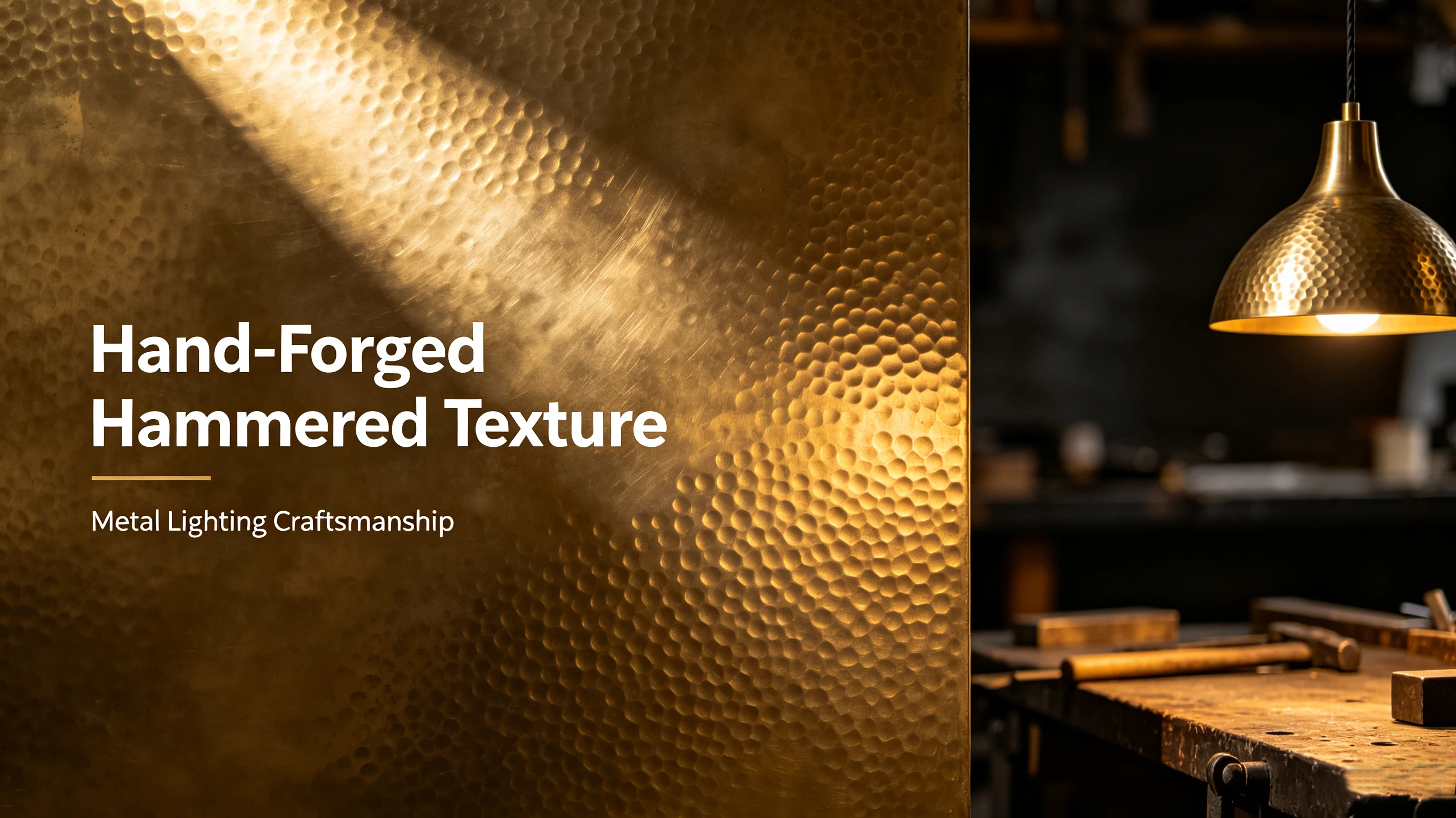
Production begins once the engineering drawings are approved. Brass tubes and sheets are cut with CNC or laser equipment, then bent on hydraulic benders or shaped by hand for organic, branch-like forms. For sculptural pieces, metalworkers heat and forge solid brass to recreate natural knots and curves, a process machine stamping cannot reproduce.
The parts are then joined with precision TIG or MIG welding. Each joint carries its share of the finished load, and large frames receive internal reinforcement where the span requires it. The welded frame is then checked against the drawing for symmetry, arm spacing and balance before any surface work begins.

3. Grinding and Polishing: From Raw Welds to Mirror Brass
A welded frame is not yet beautiful. Every weld bead is ground and blended until the joint disappears, and cast components have their gates removed before detail grinding. This stage is slow and unglamorous, but it defines the quality buyers feel rather than see: a poorly blended joint shows through the finish for the fixture’s entire life.
Polishing comes next, combining mechanical buffing for broad surfaces with hand polishing for intricate areas. The goal is a uniform surface across the frame, smooth enough to reflect light evenly. Mirror-polished brass is the classic result, but polishing also prepares the surface for plating, where even a tiny imperfection is magnified.

4. Plating, Patina and Protection: The Art of Metal Finishing
Many fixtures receive a plated finish: electroplating in brass, gold, nickel or black nickel, PVD vacuum deposition, or hand-brushed surfaces. Producers control colour variation tightly, measure plating thickness and keep gloss within a set range so every arm matches. Antique brass follows a different route: a chemical patina is applied and partially buffed back, leaving recesses dark and raised surfaces light.
Whatever the finish, protection is the final step. Clear lacquer, wax or nano coatings seal the surface against oxidation and handling. The finish also affects maintenance: polished brass can be restored decades later, while a sealed antique patina stays stable with minimal care.

5. Assembly, Lighting Test and Final Quality Control
With finishing complete, the chandelier is assembled for the first time as a whole fixture. Arms are fitted, glass and crystal hung, and LED modules, wiring and drivers installed to the electrical layout. This dry assembly lets the factory catch misaligned parts or poor fits while everything is on site.
It is then lit for a full electrical and lighting test, checking brightness consistency, colour temperature, dimming response and safe operation. Inspectors verify arm balance, finish and structural integrity against the specification, and only fixtures passing the lighting inspection move to export packaging. For the buyer, this guarantees the chandelier performs exactly as approved.

The craft of a custom chandelier is mostly invisible. Guests remember the glow, but it depends on dozens of steps, cutting and welding, grinding and polishing, plating and testing, each checked before the next. Understanding it helps buyers compare factories honestly and choose fixtures built to last beyond opening night.
If you are a trade customer and interested in R&C products please contact us:
If the lights you are looking for is not on my scope, Need to bespoke design. Please contact our salesman and I will email you back within 24 hours. For further information please email me on: //www.rcdecolighting.com/contact-us.html or call me on : +86 13822380843
The Art of Hand-Blown Glass Chandeliers: Craft Behind Custom Hospitality Lighting


Follow us
For more information about our non-standard lighting customizations, please contact us, simply fill in your details below and let us keep you up to date with the latest product letters with quotes, news, events and stories.
E-mail:
WhatsApp:
+86 138 2238 0843
Wechat:
+86 130 0550 5776
Address:
5 Xinmao Industrial Avenue, Zhongshan City, Guangdong Province, China
(R&C DECO LIGHTING)
Subscribe the newsletter