The Art of Hand-Blown Glass: Crafting Custom Chandelier Shades From Molten to Masterpiece
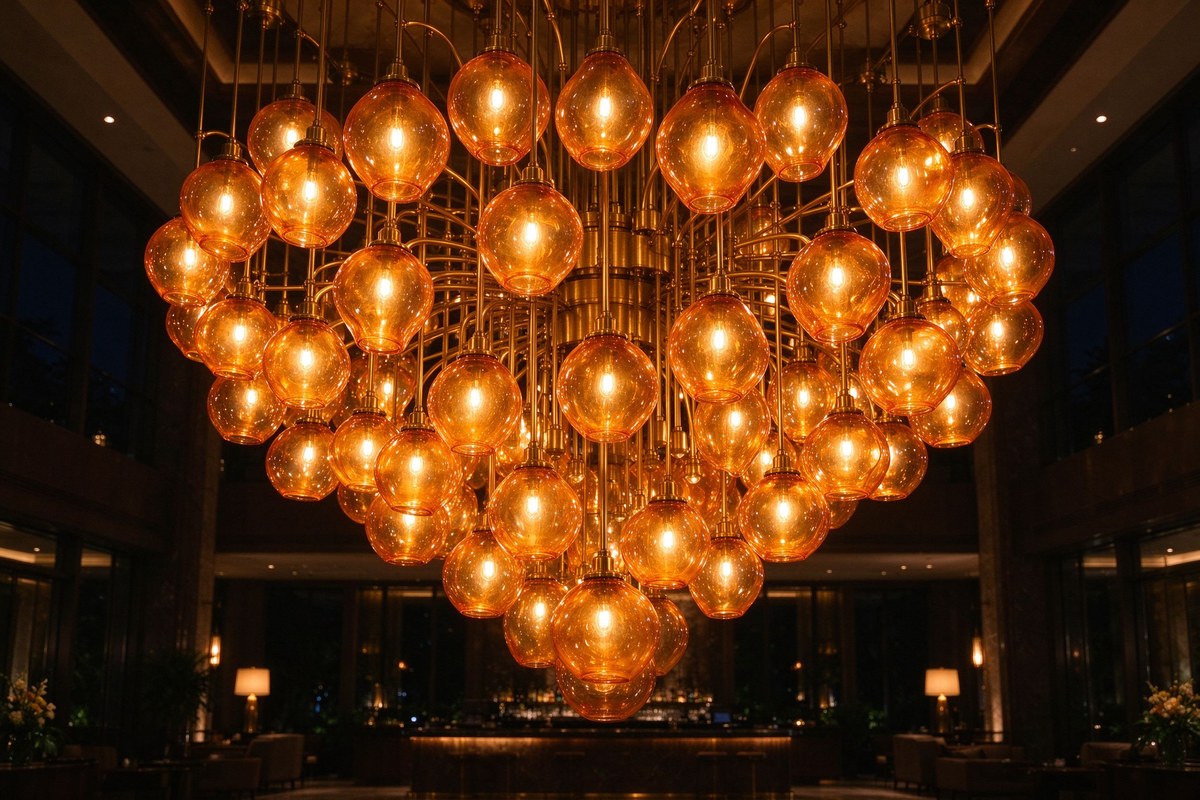
Many of the most memorable chandeliers in luxury hotels are remembered not for their metal frame but for their glass: softly glowing amber shades, rippled clear globes, petal-like forms that diffuse light into a warm pool. A growing share of those shades are hand-blown, made one at a time by a glassworker with a blowpipe rather than pressed in a machine mould. It is one of the oldest ways to form hollow glass, and it is also the most demanding. Understanding how hand-blown glass is made helps buyers appreciate its value, set realistic expectations and specify it correctly for bespoke lighting projects.
Why Choose Hand-Blown Glass for Custom Fixtures
What makes hand-blown glass worth the extra cost over a machine-made shade? Machine pressing delivers uniformity and a low price, but it cannot easily produce the organic, irregular forms that define high-end decorative lighting. Hand-blown glass carries subtle variation in curve, thickness and light refraction that gives each piece a living quality, and it allows colour to be worked into the molten body rather than painted onto the surface. For a bespoke chandelier, this means designers are not limited to a catalogue shape: globes, petals, discs, tubes and free-form sculptural shades can be developed for a single project. The trade-off is that the process is slow, energy-intensive and requires a tolerance for small, controlled variation.

Gathering and Blowing: Working at Extreme Heat
The process begins at the furnace. Raw glass is melted to a honey-like liquid at temperatures above one thousand degrees, and the glassworker gathers a glowing mass onto the end of a hollow steel blowpipe. Even a few seconds of inattention matter: liquid glass responds constantly to gravity, so if the artisan stops rotating the pipe, the gather sags and loses its centre. By rolling the pipe and blowing into it, the worker inflates the gather into a hollow bubble, called a parison, and transfers it back and forth between the furnace and the bench to keep it at the precise working temperature. Speed and restraint are equally important here; the artisan moves the glass rather than forcing it.

Shaping, Colour and Texture
Once the bubble is established, the real shaping begins. Traditional hand tools such as wooden paddles, jacks, tweezers and shears form the neck, open the mouth and define the silhouette, while gravity and constant rotation keep the piece symmetrical. Colour is introduced by rolling the hot gather in coloured glass chips or pulling coloured rods, so the hue runs through the wall of the shade instead of coating its surface. Texture, such as a ripple or rib, is created by blowing into a textured mould while the glass is still soft, or by pressing tools into the surface. These refinements are what control how the finished shade reflects and diffuses light, which is why they are refined while the glass is still hot, not corrected afterward.

Annealing: The Slow Step That Makes Glass Safe
When the final form is reached, the glass is cracked off the pipe and moved immediately into an annealer, a specialised oven that slowly lowers the temperature over roughly twelve to twenty-four hours. This step looks passive but it is the most important safety stage in the process. Glass that cools too quickly traps internal stress, and a shade that appears perfect on the day of delivery can crack months or even years after installation. A controlled annealing schedule releases that stress, particularly as the glass passes through its strain point, and gives the finished piece the strength and stability needed to hold a lamp and survive export. Buyers should always ask about the annealing cycle rather than assume it is standard.

Finishing, Inspection and Batch Consistency
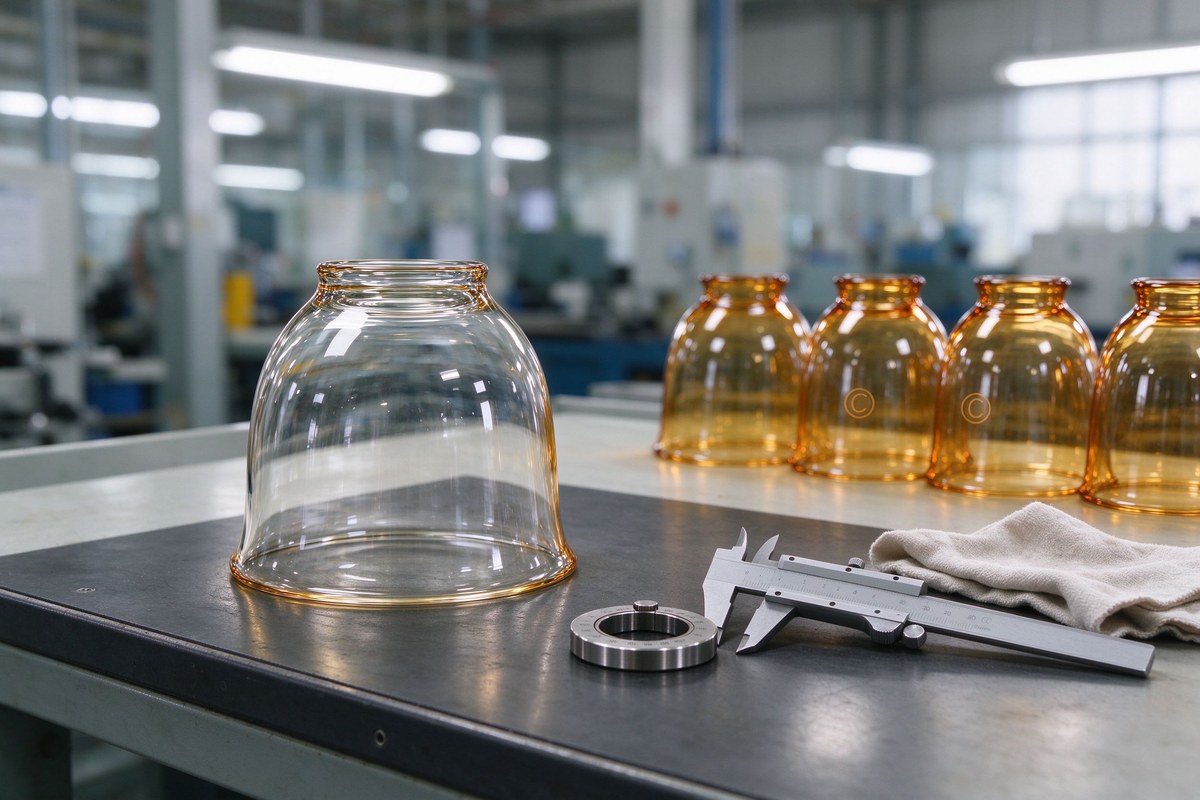
The final stage is finishing and quality control. Cooled shades move through cutting, grinding, polishing and washing, and the neck fitter is ground so the shade seats into the metal hardware without rattle or pressure. For commercial orders, the fitters are checked against gauges to tight tolerances, while every shade is inspected for cracks, scratches and uneven wall thickness. Because hand-blown glass is inherently varied, the practical goal is not perfect identity but controlled consistency: pre-production samples are approved first, and batches are compared for colour and form so the full chandelier reads as one family. Specified and checked correctly, hand-blown glass turns a custom chandelier into a genuine signature piece.
If you are a trade customer and interested in R&C products please contact us:
If the lights you are looking for is not on my scope, Need to bespoke design. Please contact our salesman and I will email you back within 24 hours. For further information please email me on: http://www.rcdecolighting.com/contact-us.html or call me on : +86 13822380843
How Custom-Cut Crystal Is Made for Bespoke Chandeliers: K9 Optical Crystal, Faceting and Light Refraction
From Wax to Brass: The Lost-Wax Casting Craft Behind Custom Lighting


Follow us
For more information about our non-standard lighting customizations, please contact us, simply fill in your details below and let us keep you up to date with the latest product letters with quotes, news, events and stories.
E-mail:
WhatsApp:
+86 138 2238 0843
Wechat:
+86 130 0550 5776
Address:
5 Xinmao Industrial Avenue, Zhongshan City, Guangdong Province, China
(R&C DECO LIGHTING)
Subscribe the newsletter