How Custom-Cut Crystal Is Made for Bespoke Chandeliers: K9 Optical Crystal, Faceting and Light Refraction

K9 Optical Crystal vs Lead Crystal: What Trade Buyers Should Specify
The word crystal is used too loosely on custom chandeliers. Pressed glass, lead-free optical glass and full-lead crystal are three different materials producing three very different levels of sparkle. For a hotel or restaurant statement piece, specifying the crystal grade correctly matters as much as the metal finish, because the pendants are the surface guests photograph.
K9 is a high-clarity, lead-free optical glass for custom chandelier pendants, with a refractive index of roughly 1.5 and no lead, so it is lighter and accepted under modern material rules. Full-lead crystal, 24 percent or more lead oxide, reaches 1.55 to 1.62 with stronger rainbow flashes but is heavier and more costly. For most hospitality projects, well-cut K9 balances clarity, cost and weight; the quotation should state grade and cut method.

From Blank to Brilliance: Cutting, Faceting and Polishing
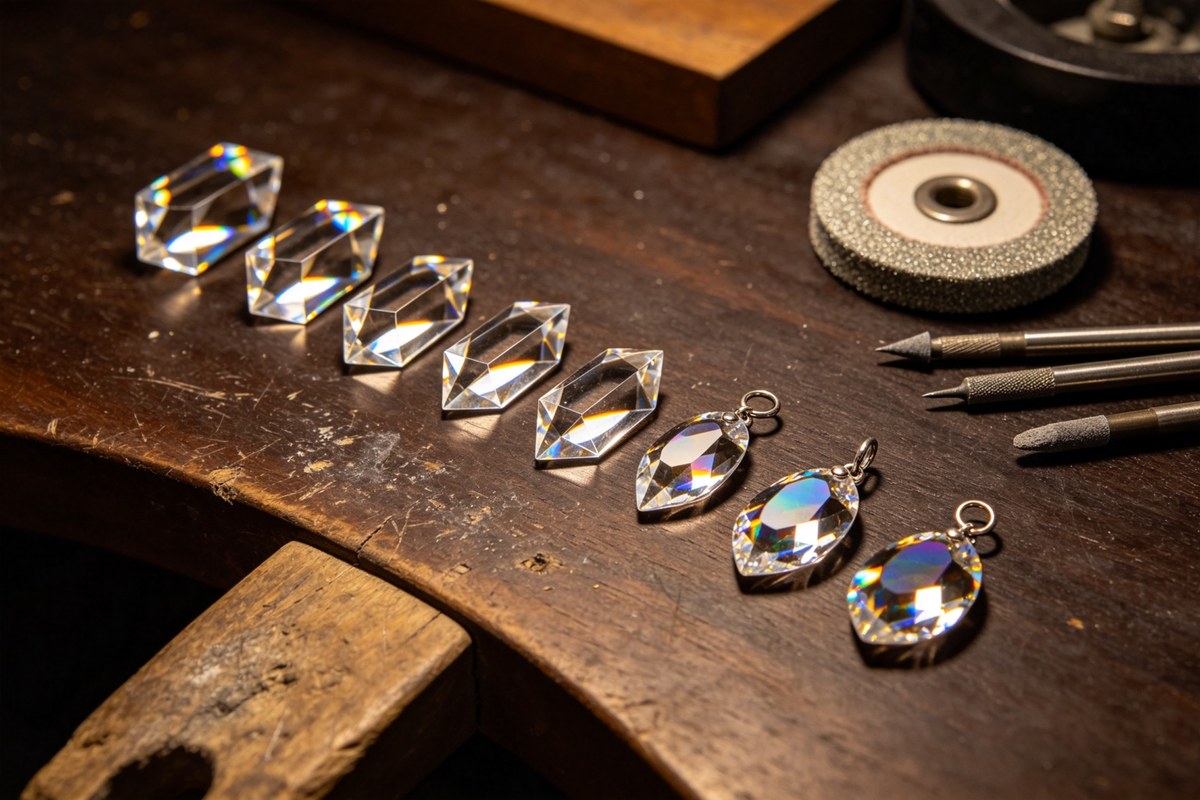
A crystal pendant begins as a cast or pressed blank, which is only the starting point. A smooth uncut bead returns light as a soft glint; brilliance is created by cutting flat angular facets, each a small mirror that catches and redirects light. Turning a dull blank into a bright pendant means grinding, faceting and polishing, and the final polish separates a premium from a cheap piece.
The blank is first ground to its profile, such as a drop, ball, prism or octagon. A diamond wheel then cuts the facets at fixed angles, from a few faces on a budget bead to several dozen on a precision prism. The piece is ground through finer grits and polished on felt or wood wheels until every facet is flat and transparent. Under-polished crystal looks milky, so the factory keeps a master sample; complex cuts add cycle time and cost.
How Facet Count and Angles Create the Sparkle
Sparkle is geometry, not magic. When light enters a crystal it bends, reflects internally and exits through another facet. Refraction controls how much it bends, while dispersion splits white light into its colours. The size, number and angle of the facets decide how many times light is redirected and whether colour appears as tight pinpoints or broad washes, so accurate facets throw small flashes as guests pass.
This is why the same K9 can look cheap or expensive depending on the cut. A lightly faceted bead gives a gentle shimmer for intimate dining rooms, while a precision-cut prism with many facets produces sharp rainbow flashes for double-height lobbies. Warm 2400K to 2700K light emphasises gold tones; cooler light gives whiter pinpoints. A large fixture can use a few complex-cut hero pieces and fill the rest with uniform beads, with a sparkle sample reviewed under the chosen LED colour temperature.

Matching Crystal to the Metal Frame: Grading, Hanging and Quality Control
Crystal is only as good as the frame that carries it. On a bespoke chandelier, hundreds or thousands of pendants hang from a brass or steel armature by hooks, pins or rings. The metal geometry, spacing and drop lengths must be engineered before the first crystal is cut, because a heavy crystal curtain changes the load on the canopy and ceiling; the frame and crystal are developed together.
Before assembly, pendants are graded for clarity, colour and cut consistency; cloudy pieces, chips and mismatched sizes are removed. Pieces are sorted by pattern and length and hung layer by layer to a map on stainless steel pins and closed rings that will not slip during cleaning. Quality control runs in three layers: pendants are checked against the master, the full fixture is trial-assembled and lit to confirm sparkle and symmetry, and a labelled spare overage is packed so a broken bead never delays an opening.

Specifying Custom Crystal for Hotel Chandeliers: Shapes, Sizes and Lead Times
A useful brief is not a single reference photo but a clear specification: the crystal grade (K9 optical glass is the usual default for large projects), the cut level, preferred shapes, drop-length range, curtain density, and the LED colour temperature and dimming. Include the physical data: ceiling height, fixture diameter and weight, fixing details, and any wind or vibration risk in a tall lobby.
Common shapes include octagons, almond and leaf drops, round and flat balls, and long prisms, often combined so a central ring uses larger hero pieces and the outer layers use smaller uniform beads. Standard shapes and limited sizes keep cost and lead time down and guarantee easy spares; fully bespoke cuts need new tooling, so plan six to ten weeks ahead. Confirm cleaning access, spare coding and partitioned export packaging.

If you are a trade customer and interested in R&C products please contact us:
If the lights you are looking for is not on my scope, Need to bespoke design. Please contact our salesman and I will email you back within 24 hours. For further information please email me on: http://www.rcdecolighting.com/contact-us.html or call me on : +86 13822380843
Etched and Frosted Glass How Custom Pattern Transforms Bespoke Lighting Shades
The Art of Hand-Blown Glass: Crafting Custom Chandelier Shades From Molten to Masterpiece



Follow us
For more information about our non-standard lighting customizations, please contact us, simply fill in your details below and let us keep you up to date with the latest product letters with quotes, news, events and stories.
E-mail:
WhatsApp:
+86 138 2238 0843
Wechat:
+86 130 0550 5776
Address:
5 Xinmao Industrial Avenue, Zhongshan City, Guangdong Province, China
(R&C DECO LIGHTING)
Subscribe the newsletter